Read in your language:

Showing posts with label Travelling Abroad. Show all posts

Saturday, October 18, 2014

Studying The Korean Language (学习韩国语): A Review of Sogang University (서강대학교) & Hankuk University Of Foreign Studies (한국외국어대학교) in Seoul, Korea

I took Korean Language Studies at both Sogang University, and Hankuk University of Foreign Studies. Here are the differences between the two universities:

1) Application and Termination

The application process and entry requirements were similar for both the universities. A minimum of a high school diploma is required for acceptance into the course, and a certificate of admission has to be obtained from the school, before applying for a student visa while still in Singapore*.

I had trouble terminating my second term at Hankuk. They tried to dissuade me from leaving while Sogang asked no questions at all.

* I had classmates from other countries who were allowed to apply for a student visa AFTER they had arrived in Seoul.

2) Cost

A term (which for some reason they call a semester) will set you back by approximately W1480K at Hankuk, and W1560 at Sogang (please check the respective websites for the exact updated cost). However, Sogang is the only university which offers a 3-hour study day at W1350 per term, with the 1-hour writing class being optional. A very good choice for those who would like to save on cost, or those who are studying Korean just to get a long-term visa.

The difference in the cost of textbooks and workbooks is negligible. A set of books for a particular level costs around W50K.

3) University Environment, Facilities, and the Surrounding Area

Hankuk University had a newer feel to it, compared to Sogang University. Both universities however, were undergoing construction to add new buildings and wings to the old structures.

Hankuk University Seoul Autumn

Autumn at Hankuk University Of Foreign Studies

There is an Olive and Young (similar to Watsons) on the grounds of Hankuk University, whilst there is a small Bandi and Luni's bookstore on the grounds of Sogang University. Both universities have canteens with reasonably-priced food, and of course, a library and a school clinic.

The area just outside of Hankuk University comprises of shops and eateries in two long rows leading all the way to the subway station. At lunch time, I would pop by to grab a bun from the bakery, or a latte from Coffee Bean. There are also a couple of cosmetic shops and a Daiso.

The area outside Sogang University isn't as hip, comprising of traditional hole-in-the-wall eateries and greengrocers. However, the trendy and bustling streets of Sinchon and Edae are just a 15-minute walk away.

3) Classroom Environment

The classrooms at both universities are air-conditioned, but Hankuk had tried to cut down on air-conditioning costs by leaving the air-conditioner on for only an hour, then switching it off, which made the classroom horribly stuffy.

The average age of students taking the Korean Language course is within the range of 18-26, although there is the odd 16 or 40-year-old.

Hankuk adopts a U-shape seating arrangement in the classroom, whilst at Sogang, students are grouped in tables of 3 or 4, to facilitate interactive classroom activities.

classroom Hankuk University Of Foreign Studies Seoul

Classroom layout at Hankuk University

4) Lesson Timetable

There are a total of 7 levels for the Korean Language Course. Each level spans a period of 3 months, inclusive of public and school holidays, and comprises 200 hours of lessons.

Both universities have morning and afternoon sessions, but it is not a choice for the student. At Sogang, the full 4-hour course is in the mornings, and the 3-hour course is in the afternoons. At Hankuk, levels 1 and 7 are conducted in the afternoon, while levels 2-6 are conducted in the morning.

A 4-hour day is split into an hour each of writing, reading, listening and speaking.

Both universities have a compulsory outing day per term. Hankuk's was a paid trip to Lotte World, which I skipped, whereas Sogang's was a traditional Korean knot-making class which I thoroughly enjoyed.


5) Method of Teaching

I personally prefer the teaching method at Sogang. It is much more interactive. Students are made to leave their seats and walk around the classroom, in order to practice conversing with their fellow classmates, using vocabulary and grammar that had been freshly introduced. Interactive learning takes up at least half the lesson.

There are also a lot more worksheets being handed out, for completion during the lesson, and as homework, compared to Hankuk Univerisity. At Sogang, the teachers mark the completed assignments, and demand to see the students' corrections. At Hankuk, a portion of class time is devoted to going through the previous day's homework together, with students having to mark their own work.

6) Textbooks, Workbooks and Worksheets

I find the Hankuk textbook and workbook of a higher difficulty than Sogang's.

Sogang Hankuk Korean Textbooks


Sogang Hankuk Korean Textbooks


Worksheets from Hankuk University and workbook from Sogang University

7) Examinations

The writing, reading and listening tests at Hankuk seem to be more difficult than that at Sogang. However, I found the oral exam at Sogang more intensive and gruelling, which is no surprise, given that Sogang specialises in the spoken language.


Things I hate about Seoul (韩国生活:大讨厌)

So, having lived in Seoul for 10 months, these are the things I hate about the city:

One. Dirty streets: There is a lot of spittle on the ground. Not as bad as in China, but coming from a clean and green city like Singapore, the lack of hygiene was difficult to get used to. You can't take your eyes off the ground if you're a germaphobe.

On the weekends, you'll catch the stench of vomit along certain stretches of road, as people get themselves way too drunk.

Although recycling is strictly enforced, with threat of litigation for non-compliance, you'll still see this on the streets:

korea trash


Two. Rude chauvinistic men & other clueless people: I've had men purposely turn and spit in my direction, purposely walk head-on into me although the walkway could fit another 3 people abreast, and kick my foot on purpose in the train. These were all perpetrated by middle-aged men, who clearly belong to a different era where women were not respected.

Outright discrimination aside, there are a lot of clueless people when it comes to appropriate social behaviour. A pet peeve of mine was the opening of doors in public places. 8 out of 10 times, instead of letting the person who opens the door pass through first, the person on the other side of the door would walk right through as if you were the doorman. Also, be prepared to wait an extra 15 seconds each time the elevator stops at a level, as the person who walks in does not see the need to close the elevator door after them. The words 'thank you' (for holding the door open) and 'sorry' (for bumping into you or stepping on your feet) are almost unheard of.

Three. Korean programming: Web programmers do not follow international coding, and their online security is obviously foreigner-phobic. A special ID (i-pin) is required, in order to register oneself on most Korean websites, or to apply for membership cards. Foreigners do not have that unique ID, although the government would have you believe otherwise. Even if you manage to obtain one as a result of long-term residence, try getting the application form to load correctly, or at all. It's wasn't a Mac, Java or Flash problem. Don't waste your time trying to figure out how to be a part of their online community.

Four. High cost of living (except for accommodation and transport): Rental for my brand new studio apartment cost me S$1000 per month, excluding utilities and maintenance, which was an additional S$200. A similarly-sized apartment would probably cost upwards of S$2000 in Singapore. Transport to almost anywhere within Seoul via subway is a dollar or two at most.

Other than transport and accommodation, the cost of everything else is on par with Singapore. Eateries, many home-based, charge a minimum of $5 for a bowl of noodles or rice. The price of groceries is equivalent to that in supermarkets in Singapore. A cup of caffeine or a fast food meal costs about the same, from S$6 upwards.

kimchi jigae

A S$6 meal, similarly priced at air-conditioned food courts in Singapore.
.

Five. Smelly Subways: While tropical climates might have to contend with the stink of body odour in a packed train, the subways in Seoul have a very unique stench of kimchi on the weekdays, and kimchi mixed with alcohol on the weekends. I guess the smell doesn't bother the locals as I've even come across makeshift stalls selling fresh vegetables and fermented stuff in an underground subway station.

Six. AirconditionitisYes, you read that right. Koreans believe that such a condition exists; where you get sick from too much air-conditioning. Hence, poor air circulation and resulting discomfort when shopping in warm stuffy shopping complexes during Summer is the norm. In fact, it made shopping complexes seem kind of primitive during the Summer season.

Seven. Poor service at some places: Staff are more interested in having a conversation among themselves than in preparing your latte. I see the same thing happening among foreign service staff in Singapore these days. However, there are a great number of Mainland Chinese and Japanese tourists, and shops employ foreign labour to cater to the foreign crowd, so in that aspect, I get served reasonably well.

Eight. Not as international as I hoped it would beFew Koreans speak English, making it difficult to get to know them on a personal level. The ones that do, have usually studied abroad for a period of time, and I got to know them via Meetups, or when asking for directions.

You would be hard pressed to find authentic international dining outside of Itaewon, except for maybe Outback Steakhouse, which I frequented, just because there were 2 outlets within walking distance of my apartment. I was also grateful to find familiar Chinese food at a Crystal Jade branch in Myeongdong, although it was pricey. For Japanese food, there was CoCo Ichibanya Curry House in Sinchon, and for the daily dose of caffeine, there is Starbucks, or Coffee Bean and Tea Leaf. Oh, there's Dunkin' Donuts and Krispy Kreme too, but nothing beats Donut Factory and Chewy Junior in my opinion. I still missed the luxury of being spoilt for choice when it came to eating out.

Finally, there is the rather well-known problem of finding Western bedsheets, as a lot of Koreans still sleep on traditional mattresses placed on the floor. I spent a lot of time hunting for bedsheets for my queen-sized bed, and was horrified by the thought that I would have to spend a thousand dollars on a 'luxury set' from France. Yes, a thousand dollars for a bed sheet, 2 pillowcases, and a quilt cover. In the end, I got mine from a Muji sale, where it was marked down from S$80 to S$25 for a single lousy sheet that didn't quite fit.

Muji Bedsheet


Paradoxically, there are a lot of foreigners in Seoul. It is as international a city as Singapore, if not more so. The service industry just needs to catch up and cater to the huge international crowd.


Disclaimer: Posts like this tend to attract controversy and spur arguments. Most probably because people are not aware of, or too egoistic to accept, that opinions depend on a person's personal experience of a situation, their background, and the values they hold. Know that your mileage will vary, because everything in the world is relative to something. I'm not hating on Seoul because there are things I do love about the city.


Click here to read about what I love about living in Seoul.
Click here to read about applying for a D4(1) student visa.
Click here to read about applying for an Alien Registration Card in Seoul.
Click here to read about studying the Korean language at Hankuk University and Sogang University.

Things I Love About Living In Seoul (韩国生活:最爱)

So, having lived in Seoul for 10 months, these are some of the things I love about the city:

One. Recycling: I hated this concept when I first moved to Seoul. Having to keep cartons and bags of trash in my small studio apartment for a couple of days before bringing them down for recycling, made my studio unsightly. The fact that no instructions were given to foreigners who had no inkling of the concept of recycling, made it confusing and frustrating in the beginning. There are 7 different categories of plastics for example, and it takes experience to be able to sort them correctly. A very common mistake is to think that snack wrappers are made of plastic instead of foil and to treat tissue paper as paper for the purpose of recycling, when it should be considered trash.

recycling Seoul Korea

L-R: General trash, food scraps, light bulbs /batteries (there are another 10 bins in the basement of the building for plastics, paper, metal, glass, cloth etc)


Over a couple of months, I was horrified to discover just how much trash a single person generates, and began to appreciate the benefits of recycling. Now, back in Singapore, I still retain the habit of recycling at least 70-80% of my trash. It can be difficult at times, as recycling is encouraged but not enforced, and the recycling bins available are are not conducive to serious efforts.

At hdb estates, they have one huge blue recycling bin where you dump all recyclables without having to sort them by type. At my current apartment though, they have these tiny cylindrical bins with mini slots/holes at the top, created specifically only for sheets of paper, plastic drink bottles, and metal drink cans. Nothing else fits into them.

Although I am now a convert, my potential move to Japan next year might see me bitching about it again. Anything that is strictly enforced becomes a chore. Add the threat of a fine for incorrect sorting of recyclables, and it becomes a stressful chore.

Two. Four seasons: Coming from a country where it is hot and humid all year round, being able to experience the changing of seasons was such a joy. Watching the leaves change from green to amber then brown, walking down the streets in natural air-conditioned comfort, seeing icicles hanging off bare branches, then seeing nature come to life again in Spring was just mesmerising.


autumn haneul park seoul korea

Haneul Park in Autumn


winter Namsangol seoul korea

Namsangol Hanok Village in Winter

Three. Traditional villages and shops: My favourite place in Seoul is definitely Insadong, and the nearby Bukchon Hanook Village, which is like a mini city in itself. I could get lost among the alleyways and rows of boutique shops forever.

bukchon hanook traditional village seoul korea

Buchon Hanook Villlage

Four. Tons of skincare shops and free samples: The Faceshop, Skinfood, Tony Moly, Missha, and tons of other Korean cosmetic stores were not only everywhere, there were usually 2 or more branches in the same area. Prices are at least 40% cheaper than in Singapore, and you get tons of freebies and samples. Not to mention, membership cards for point collection and redemption of free gifts.


The 3 items in the middle were what I purchased, the rest were free gifts.


The bottle on the right was what I purchased, the rest are free gifts.


Five. Cheap train fares and cute t-money: Train fares from one end of Seoul to the other costs no more than W2000 (which is about (S$2.20). Most single trips cost a standard W1000 and you get a discount of W100 by using t-money.

subway angry bird hello kitty seoul korea

Angry Bird and Hello Kitty T-money 

Six. Economically perorated kitchen rolls: Kitchen rolls are perorated so that each piece is half the normal size of that you'd find in Singapore. If you can't picture it, each piece is basically half a standard square. If you happen to need a bigger piece, all you have to do is to tear it at the second perforation line, but I like the fact that I am given an option.

Seven. Yummy flavoured popcorn and bbq squid as cinema snacks: Think Garretts. Cheese and caramel, and berry and white chocolate popcorn. Not to mention piping hot bbq squid you eat with your fingers. Oh, did I mention downing cans of beer while watching a movie too?

gourmet popcorn cinema seoul korea

Gourmet Popcorn at CGV

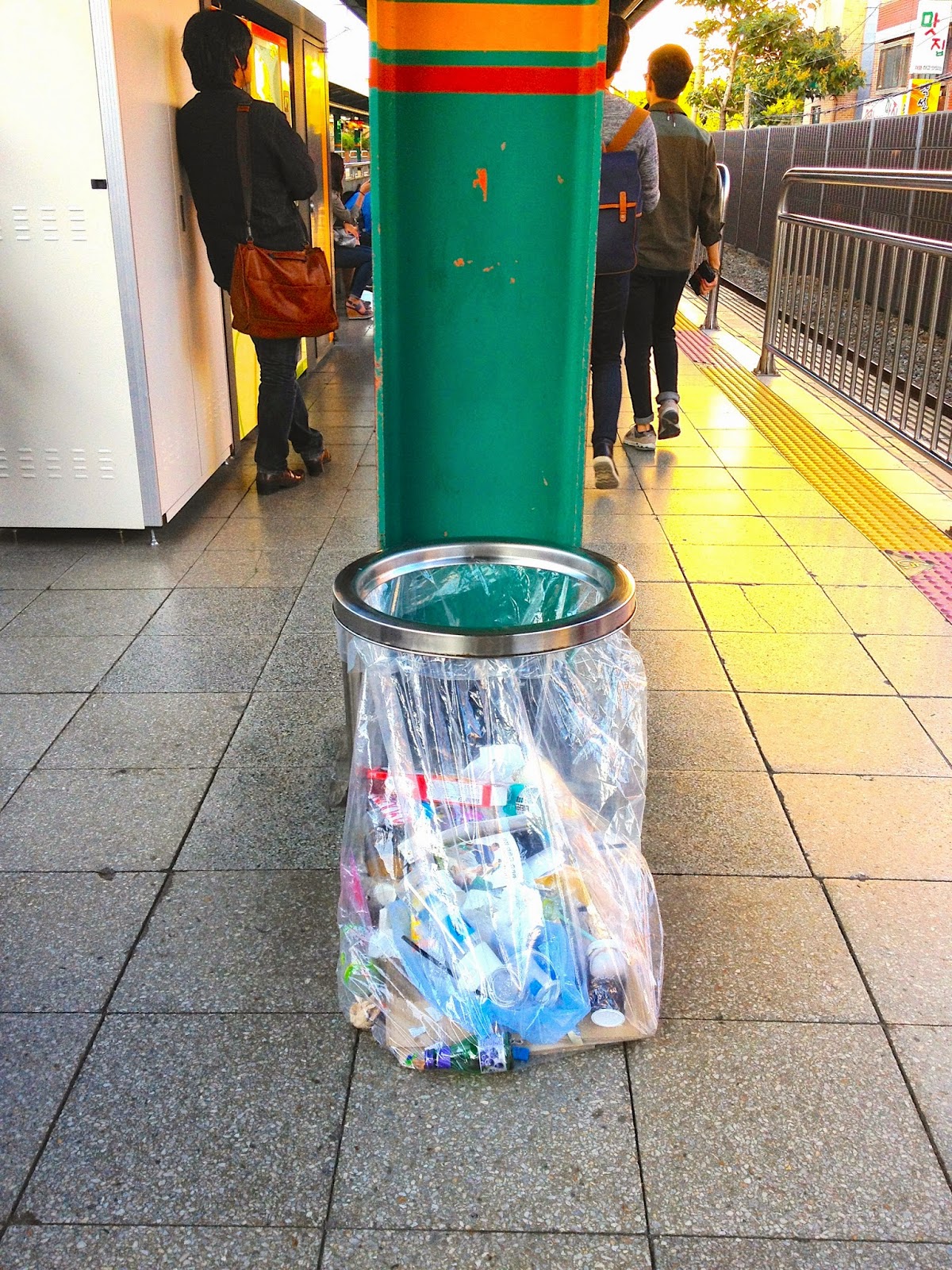
Eight. Ingenious idea of having see-through garbage bins in train stations: As opposed to the situation in Singapore, where there are no bins in the subway stations due to the potential of a bomb threat, the Koreans have come up with the ingenious idea of having bins lined with clear plastic. No more carrying of trash in your hand or bag throughout your journey, should you happen to finish that last mouthful of water or snack, just as you enter the subway station.

bins train station seoul korea

Bomb-deterring garbage bins

Nine. Extremely nice people: This is not specifically about Koreans, but the cosmopolitan crowd in Seoul in general. You never realise just how self-centred, aloof and superficial Singaporeans are, until you've experienced the genuine warmth and generosity of strangers from different countries.


Click here to read about what I hate about living in Seoul.
Click here to read about applying for a D4(1) student visa.
Click here to read about applying for an Alien Registration Card in Seoul.
Click here to read about studying the Korean language at Hankuk University and Sogang University.

Monday, August 18, 2014

Applying For An Alien Registration Card in Seoul (Korea)

If you are going to stay in Seoul for more than 90 days, you must apply for an Alien Registration Card at the Immigration Office. It is beneficial to obtain the Alien Card as soon as possible because you will need it to sign up for various services (mobile/broadband/bank account etc) as well as to get membership cards from skincare and book shops.

Which of the 2 offices you have to go to depends on your residential address.

Seoul Immigration Office

You can either print and fill out the form in advance, or fill it up at the Immigration Office.

Seoul Immigration Office Alien Card


The queue tickets for Mainland Chinese runs out before noon due to the sheer number of applicants.

Seoul Immigration Office Alien Card

The waiting time varies. I've waited from 2 hours to 5 hours. In my opinion, the best time to go is around 1pm or just before closing. You can open a Woori bank account while you wait for your number to be called.

Seoul Immigration Office Alien Card


Bring Along:

Application Form
Passport
Certificate of Admission (University)
Tenancy Agreement (Accommodation)
2 color photos (3 x 4cm)
Cash 20000 Won

Seoul Branch
Omokgyo Station, Seoul Subway Line 5, Exit 7. A 15 minute walk.

Sejongno Branch
Jonggak Station, Seoul Subway Line 1, Exit 6. 2nd For, Seoul Global Center

Please check the official website for updated information.


Click here to read about what I love about living in Seoul.
Click here to read about what I hate about living in Seoul.
Click here to read about applying for a D4(1) student visa.
Click here to read about studying the Korean language at Hankuk University and Sogang University.


Saturday, August 17, 2013

Going to Seoul on an Student Visa D4(1) (申请韩国学生签证)

If you are going to be a language student in Korea for more than 3 months (one term), you would need to obtain a D4(1) Visa. It takes about a week from the date of application to get the visa on your passport (it could be faster or slower depending on the number of applicants). You have to enter Korea within 3 months, and you will be given an extra month to settle into the country, look for accommodation, take the placement test etc.


You can either print out the application form from the website:

http://sgp.mofa.go.kr/english/as/sgp/visa/issuance/index.jsp

or get a copy at the embassy. There is also a photocopier and photo booth for use.

korea embassy visa application singapore

Be prepared to wait up to 4 hours from the time you submit your documents to the time your number gets called for a general evaluation of your suitability for a visa. The waiting time for visa collection is shorter. I waited less than 2 hours.

korea embassy visa application singapore


Bring along:

Certificate of admission from the university in Korea
2 passport sized color photos (3.5 x 4.5 cm)
Visa application form
Passport with more than 6 months validity
Updated bank book with a balance of more than $2500
Cash (check the website for the updated fees)


Embassy Of The Republic Of Korea

Consular Section: 47 Scotts Road
                             #16-03, 04, Goldbell Towers,
                             Singapore 228233
                             9 AM to 11:30 AM, Mondays to Fridays

(Second building beside Newton MRT)


Click here to read about what I love about living in Seoul.
Click here to read about what I hate about living in Seoul.
Click here to read about applying for an Alien Registration Card in Seoul.
Click here to read about studying the Korean language at Hankuk University and Sogang University.


Wednesday, June 27, 2012

Malacca Day Trip (马六甲一日游)

I had wanted to go to Malacca for some time, but the boy was worried about driving into Malaysia in our small little car. Until a pump attendant said that it was safe precisely because of this. Lol.

I asked the boy if we needed a Touch and Go card and he said no. We ended up having to get one in the end, as most toll stations do not accept cash payment. It cost us RM20 with a RM10 value which I thought was ridiculous. The first toll is at the Singapore checkpoint and cost us S$3.20 (the same charge applies when you re-enter Singapore), followed by four more tolls on the way to Malacca which cost us approximately RM16 in total. The first three tolls were within the first half-hour, and the last toll just before we entered Malacca. The return journey cost us approximately RM58 in total.

We left our home at 7am on a weekday and there were less than 10 cars ahead of us at the checkpoint. There was no traffic jam after the Checkpoint, and although the maximum speed limit is 110/hour, we travelled at 130km/hour for more than half the journey when we saw all the other cars zooming past us. The best way to drive is to stay on the innermost lane, and when you notice the car behind catching up on you, switch one lane to the left to let it pass. At the speed we were going, it took us just two hours to reach Malacca once we were through the Tuas checkpoint.

Once you are on the Malaysian highway, go straight all the way until the highway splits into two, towards KL/Melaka on the left,  and towards JB on the right. It is a bit tricky to find the town centre, but once you see the sign below, it's time to enjoy!

Malacca Day Trip

We parked on Jonker Street and went to the various attractions on foot, since they were mostly within walking distance from each other. There are parking lots along the street, and you can get individual parking coupons from some of the shops there. These coupons will cost you RM0.10 more than if you buy them by the booklet, but parking is so incredibly cheap we didn't mind.

Malacca Day Trip

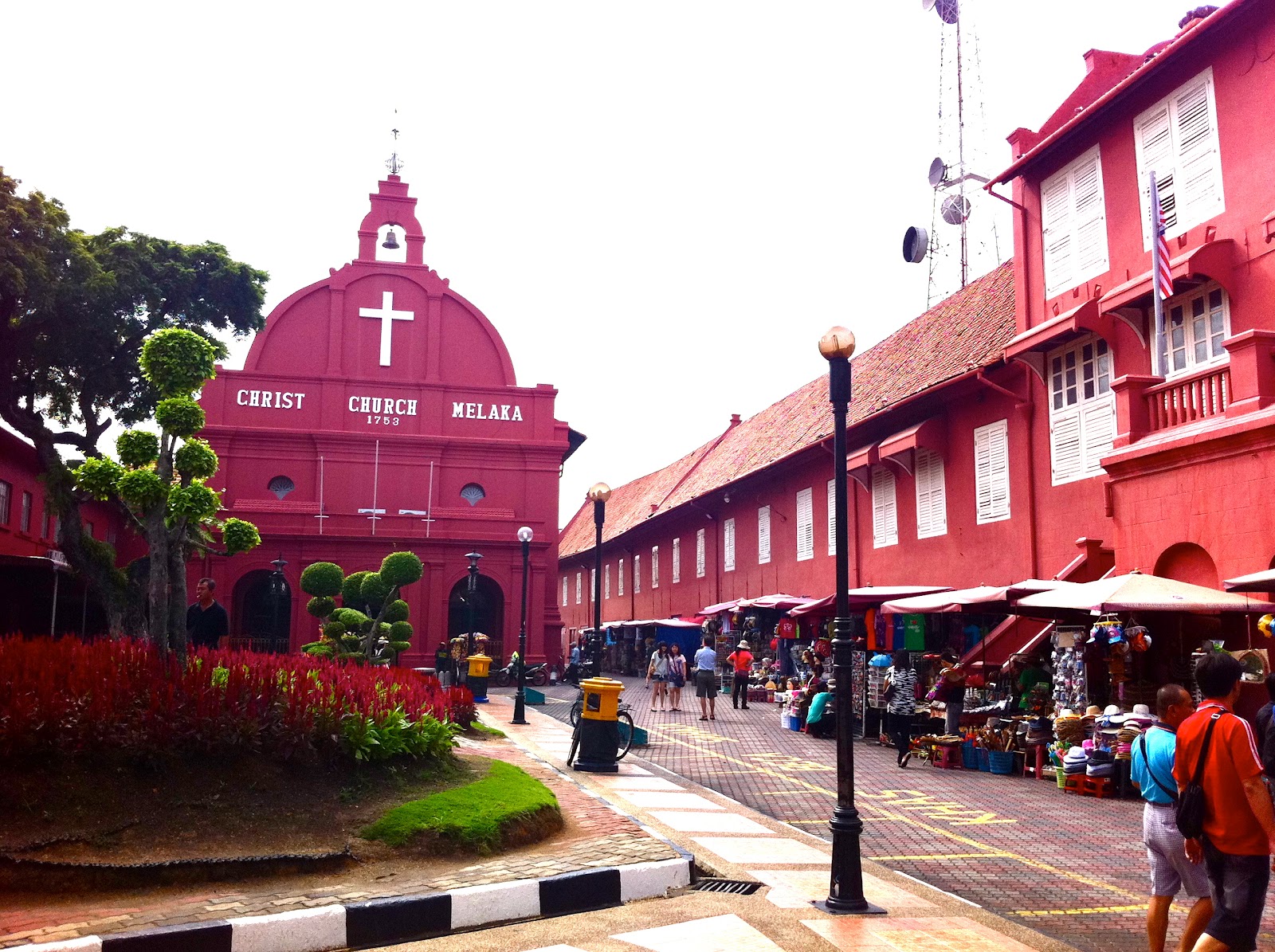
Our first stop was Dutch Square, where the Christ Church Melaka, and a day market was. You could park for a couple of minutes by the side of the day market, but it is preferable to get a permanent lot at Jonker Street and walk the ten minutes there. Since it was our first time to Malacca, we stopped at Christ Church first, as we had no idea where we could park, or how far the attractions were from each other.

(Christ Church was built in 1953 to commemorate 100 years of Dutch occupation in Malacca, and no expense was spared. Each ceiling beam was cut from a single tree, and the pews were elaborately hand carved.)

Malacca Day Trip

Once we found a parking lot at Jonker Street though, we decided to head for the popular Assam Laksa at Jonker 88. Jonker Street isn't very big, so just walk around the area to discover other yummy food like Chicken Rice Balls.

Malacca Day Trip

I had my fave assam laksa and the boy had the normal laska. The ingredients were similar for both, except that the boy had a hard boiled egg in his laksa, and I had sardines in mine. Unlike the assam laksa in Singapore, this one had yong tau foo and prawns in it. The sardine also came in huge chunks instead of being finely mashed and distributed throughout the soup, which is equally sour and spicy.

 Malacca Day Trip

Malacca Day Trip

The noodles are larger and chewier than the Singapore version, similar to Mee Tai Mak.

Malacca Day Trip

After our breakfast, we headed back in the direction of Christ Church and saw policemen on horses. Horses in the city, that's a first for me!

Malacca Day Trip
Up a little hill you will find the ruins of St Paul's Church, which to me, is the most beautiful sight in Malacca even if the walls are moldy and the place smells sourish. There are stone tablets with inscriptions, tombstones and exhumed graves, and the walls are beautifully weathered. Inside, you'll find artists displaying their sketches and paintings on makeshift tables in the hope of selling a piece or two.

Malacca Day Trip

Malacca Day Trip

Malacca Day Trip

Malacca Day Trip

Through the church and down two flights of stairs, you'll get to A'Famosa. Or what's left of it. You can see Mahkota Parade (the orange building in the first picture below) and Dataran Pahlawan (the grey building in the second picture) in the distance. Well, I did say that almost everything is within walking distance :)

Malacca Day Trip

Malacca Day Trip

The Porta de Santiago, one of the gates to A'Famosa, is the only thing that's left of the fortress built by the Portugese and later destroyed by the Bristish. Saved no less by the founder of modern Singapore.

Malacca Day Trip

After loitering in the afternoon heat trying to get some decent shots, we headed for the malls, some air-conditioning, and a nice cold mug of root beer float.

Malacca Day Trip

The float whetted our appetite for more food and we headed over to Nadeje Patisserie Cafe at Mahkota Parade to try their famous mille crepes.

Malacca Day Trip

I chose the rum and raisin mille crepe and the boy had the green tea mille crepe. They cost approximately RM8 and are basically made up of flavoured cream sandwiched between many layers of crepe. I liked feeling the layers seperate as I chewed on mine. You can find something similar at Cathay cinemas by the way.

Malacca Day Trip

Malacca Day Trip

The boy had a cranberry calpis, and I had a peach calpis soda :).

Malacca Day Trip

We did not get to experience the bustle of the Jonker Street night market since we went there on a weekday. In fact most of the shops were closed during the day, and we learnt that many food stalls wrap up before noon or whenever the pre-prepared food for the day is completely sold out.

Malacca Day Trip

Rows of old shophouses. Not so Chinatown or Arab Street back home.

Malacca Day Trip

Beautiful Peranakan tiles. I want these for my new home!

Malacca Day Trip

Malacca Day Trip

We had our final meal at Tames Cafe which serves authentic Peranakan food. It is located near the entrance to Jonker Street.

Malacca Day Trip

The food was pretty good though not cheap at all. We ordered only two dishes as I was starting to get a terrible migraine from the heat, and even then, I only managed to eat the chap chye and the poor boy had to finish almost all the Babi Ponteh.

Malacca Day Trip

The chap chye tasted more like my own home-cooked version (with the strong taste of fermented soy beans) than those you get at the hawker centres in Singapore.

Malacca Day Trip

Would I visit Malacca again? Probably not, considering the five-hour drive to and fro. The food we tried was good, but not spectacular, and the two malls, though relatively huge with many shops selling items cheaper than in Singapore, didn't have anything moderately interesting. You can find Etude House and The Faceshop there though.

As we wanted to leave Malacca before it got dark, we did not have enough time to visit the Johor Premium Outlet on the same day, but it is along the same route, Exit 304, and a mere half-hour drive from the Causeway. We'll save it for a boring weekend :)

And what's a holiday without a souvenir to remember it by.